
How to Beat Holiday Weight Gain

Think Halloween is scary? Just wait until you face the tables full of Thanksgiving, Christmas and New Year’s treats. A holiday without indulging in at least a few tasty snacks is almost unimaginable but, for some of us, one treat leads to another and by Jan 1st we’ve gained the same number of pounds we gained last year and the year before and the year before that. And probably never lost.
First the good news—most of us won’t gain as much as we might think. The average weight gain between Halloween and New Year’s is less than one pound, and hopefully you’ve created a great relationship with food, will be in that group, and will only have a little work to do in January. But then again you may be a work in progress (aren’t we all?) and will land on the far right of this chart. That line shows that those who gained 5 pounds or more added most of that weight during the holidays. And studies show those who are already overweight are more likely to be the ones gaining during the holidays and also more likely to add to it during each future holiday.
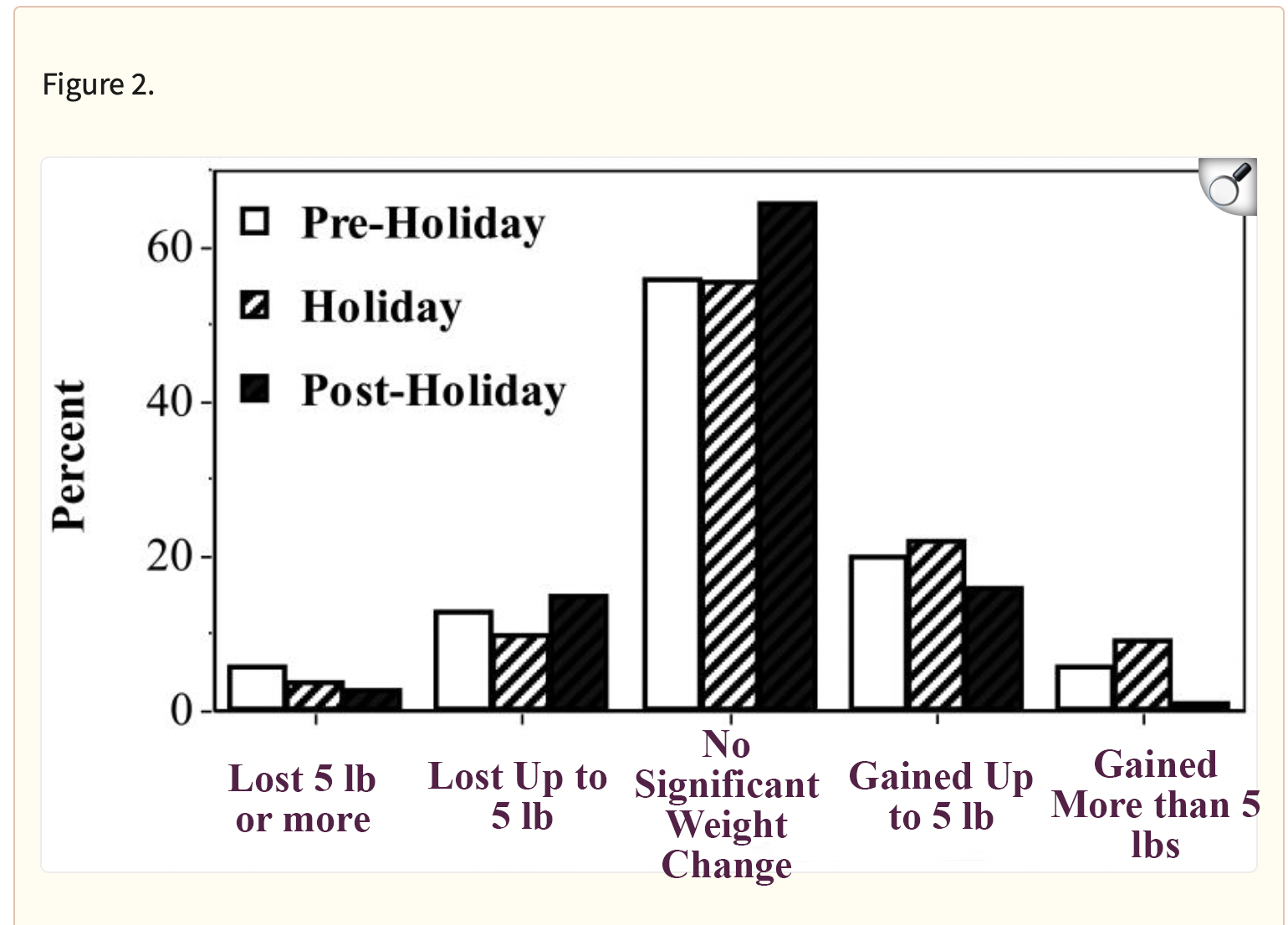
Complete study available at https://pmc.ncbi.nlm.nih.gov/articles/PMC4336296/
So how do you avoid holiday weight? We have some tips:
1) Respect your body AND your traditions. Eating healthy doesn’t mean you have to deny yourself every beloved holiday treat. Did your mother bake your favorite cookie for Christmas every year? Or maybe Grandma’s pumpkin pie was a not-to-missed part of your Thanksgiving table? Those memories are as much about love as they are about food, so indulge. But just don’t overdo it. Savor one cookie or one piece of pie while reminding yourself how special those memories are.
2) Never show up to a holiday dinner starved. It can be tempting to skip meals in order to save up the calories for a feast, but it's also easy to lose track of the big meal’s calories and that usually leads to piling your plate too high and going back for seconds. You’ll also find your metabolism works more efficiently if you stick to a routine and feed it on a regular schedule. Skipping meals just creates more hunger and we all know how hard it is to control eating when we’re hungry.
3) Space yourself during holiday meals. And that applies both to how fast you eat and where you are in proximity to food. If the gathering has a table of treats, place a few of the healthier options on your plate and walk away from the table. Then eat slowly and give your brain time to recognize your hunger has been satisfied. If it’s a sit down meal, try not to place high calorie foods like marshmallow yams directly in front of your plate, but instead keep passing them on to the others at the table. And when you’re done with your small servings of the traditional favorites, set your fork down and push your plate away to signify to yourself and others that you are done. You can still indulge in the conversation!
4) Communicate with your host. We live in a time when it’s common to be vegan or gluten-free and to feel no hesitation in making those dietary needs known, so why not feel just as free to ask ahead about healthy options? No worries if the host has a high-fat, high-calorie feast planned because that’s your opportunity to offer to bring a healthy salad, roasted vegetables or even cauliflower mock mashed potatoes (it’s delicious). Watch our PWM Monday Morning Motivation newsletter and our website during November and December for tasty and healthy substitutions for the traditional holiday recipes. We also have you covered on appetizer recipes in last month’s series of tailgate healthy recipes.

5) Stick to your healthy habits. Often your brain will confuse a lack of sleep, excessive weariness or even thirst with hunger. That craving for Halloween candy may actually be a serious need for sleep, especially during the holidays when shopping, baking, gift wrapping, home decorating and other tasks often mean late nights. So delegate those chores, trim your to-do list, and go to bed on time. If you need a reminder, your smart phone or smart watch probably has a setting that will prompt you at your wind-down time.
Moving your body is also vital, even if sundown keeps coming earlier and morning or evening walks mean bundling up. The scientific theory that a thing in motion tends to stay in motion applies to our bodies too, and if you want to have more energy (and a metabolism that burns fat efficiently) then you have to keep your body active. Don’t forget that those of a certain age may have free access to some gyms through Medicare.
6) Practice saying no. Anyone who has ever slaved over a complicated recipe knows the joy of serving that special dish to your family—it’s really an act of love. But it’s also an act of love for yourself to politely say “no” when a calorie-laden offering is made. Or maybe try a little white lie? Just tell the host how you couldn’t eat another bite right now but that looks soooo good—so could you possibly have a small serving to take home? Then later have one bite so you can honestly compliment the chef but either give the rest away or donate it to the trash bin.
7) As soon as the holiday temptation begins, start or restart a healthy eating plan. You probably already have many of the tools necessary to stay on track—daily calorie quotas, food logs, an exercise plan, a rotation of healthy recipes, etc—but if you need better tools or the motivation of an expert and caring team we’re here to help.
8) Relax! Stress levels soar during the holidays and the cortisol released is no gift to our waistlines. Figure out how to simplify your holidays and learn to enjoy them. It can be done!